About Sparkwood and 21

Experimental creative skunkworks. Fuelled by good music and damn fine coffee.

The four most useful Japanese saws for Woodworkers

Here are 4 of the most useful Japanese saws for woodworkers.

Gyokucho 400 Proton Power Saw Ibarame Kataba 240mm
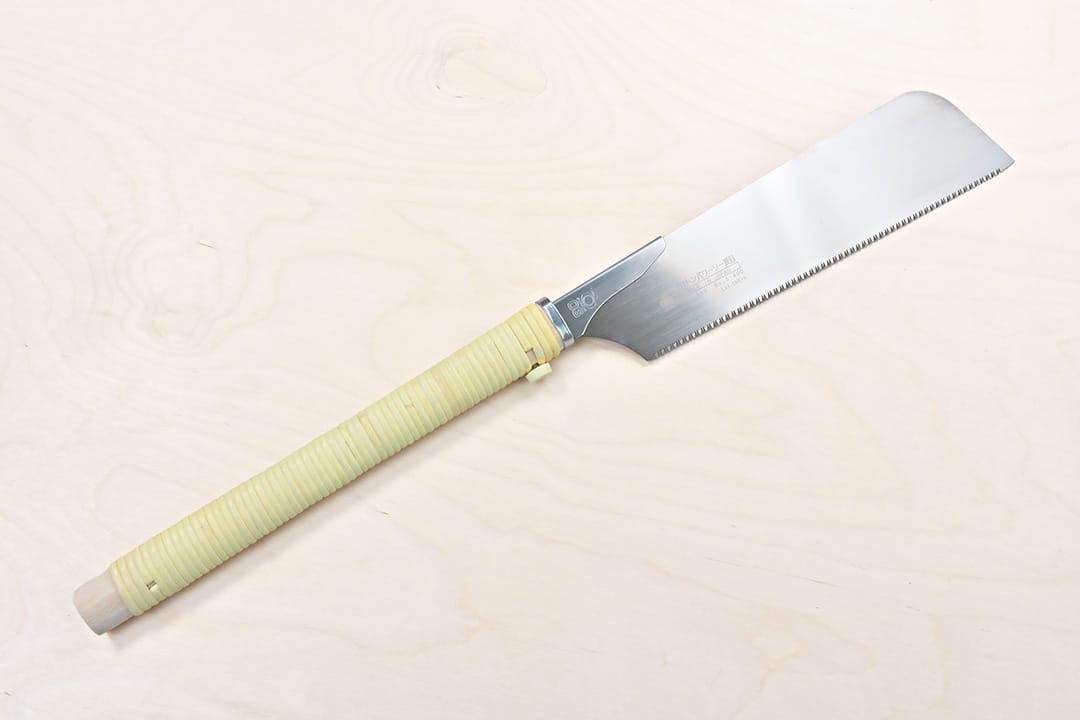
 

The Gyokucho 400 Ibarame Kataba has quite a stiff blade and 13 crosscut teeth per inch. This reasonably aggressive saw is excellent for crosscutting timber to length, making square or angled cuts for larger scale joinery and is also a great choice for zipping through panels in solid timber, sheet goods, veneered ply and composites.

It leaves a smooth surface and almost no breakout on the exit side. The stubby spine provides a little extra support for the blade whilst still allowing deep cuts to be made.

Blade length: 240mm
Overall length: 550mm
Blade thickness: 0.6mm
Pitch: 1.9mm / 13 tpi
Set: 0.125mm per side
Max depth of cut: Unlimited
Traditional rattan wrapped paulownia wood handle
Replacement blade: S400

Gyokucho 651 Blue Hard Ryoba Komame 240mm
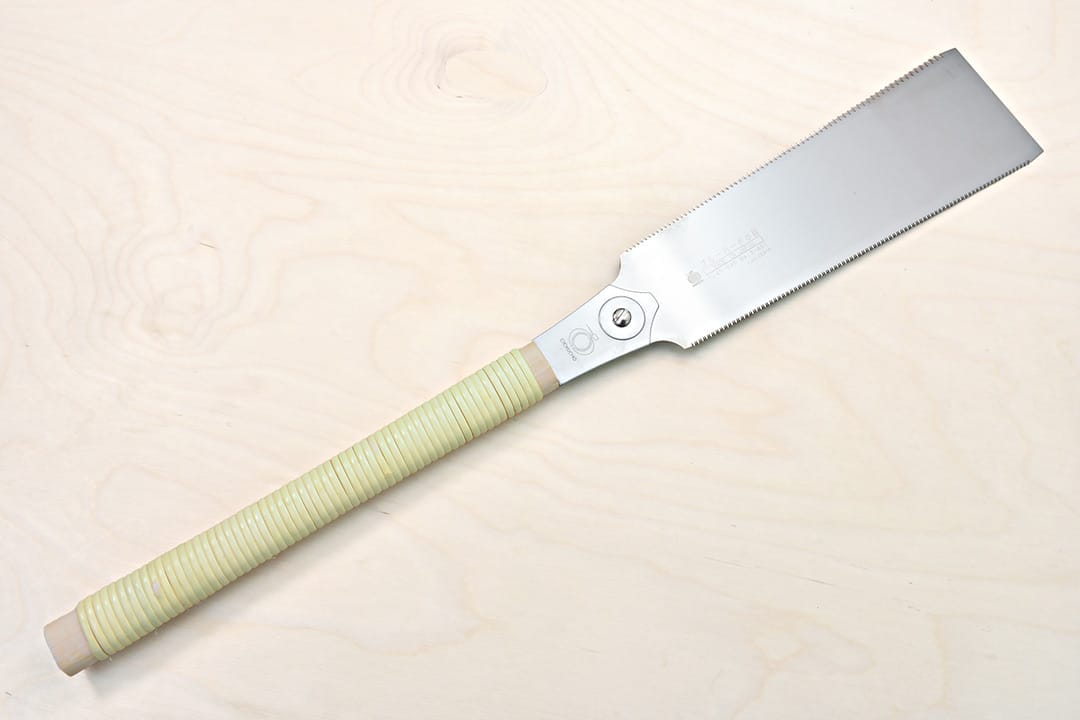
 

An excellent general purpose saw for the cabinetmaking workshop, the Gyokucho 651 ‘Blue Hard’ Ryoba Komame has progressive rip teeth on one side of the blade and 20tpi crosscut teeth on the other. It has a slightly squarer blade, a thinner plate (0.45mm) and finer teeth than the standard range of Ryoba, making it much better suited to light, accurate work.

Blade length: 240mm
Overall length: 580mm
Blade thickness: 0.45mm
Blade depth: 65mm to 82mm
Crosscut pitch: 1.2mm / 21tpi
Progressive rip pitch: 2.5mm to 3.9mm / 10 to 6.5 tpi
Set: 0.125mm per side
Max depth of cut: Unlimited
Traditional rattan wrapped paulownia wood handle
Replacement blade: S651

Gyokucho 303 Tatebiki (rip) Dovetail Dozuki 240mm
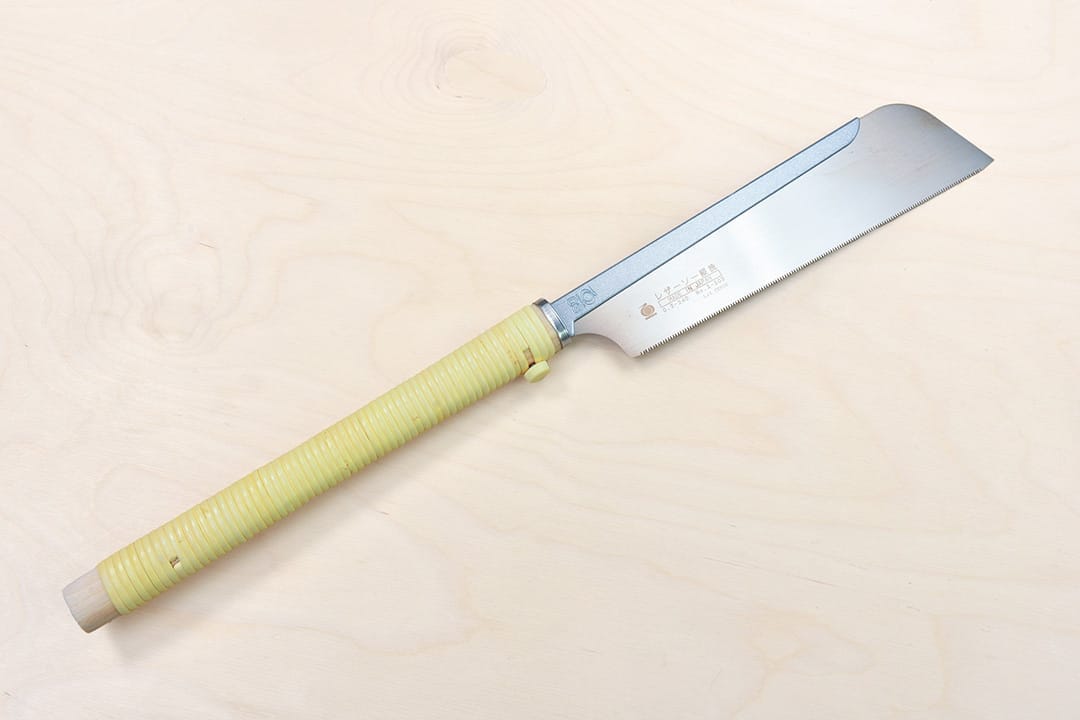
 

Purpose designed as a dovetail saw for the export market, the Gyokucho tatebiki (rip) dozuki is an absolute delight to use. Fast and smooth, it cuts beautifully under its own weight and is also very easy to keep on-line, the saw is designed for 6 – 18mm thick material with optimum performance at 12mm

The thin (0.3mm) blade removes very little material and leaves a clean surface for maximum joint strength.

Blade length: 240mm
Overall length: 550mm
Blade thickness: 0.3mm
Pitch: 1.5mm / 17tpi
Set :0.1mm per side
Max depth of cut: 45mm
Traditional rattan wrapped paulownia wood handle
Replacement blade = Part No S303 (S306 and S311 blades will also fit this saw)

Gyokucho 1151 Double Edged Flush Cutting Saw 125mm
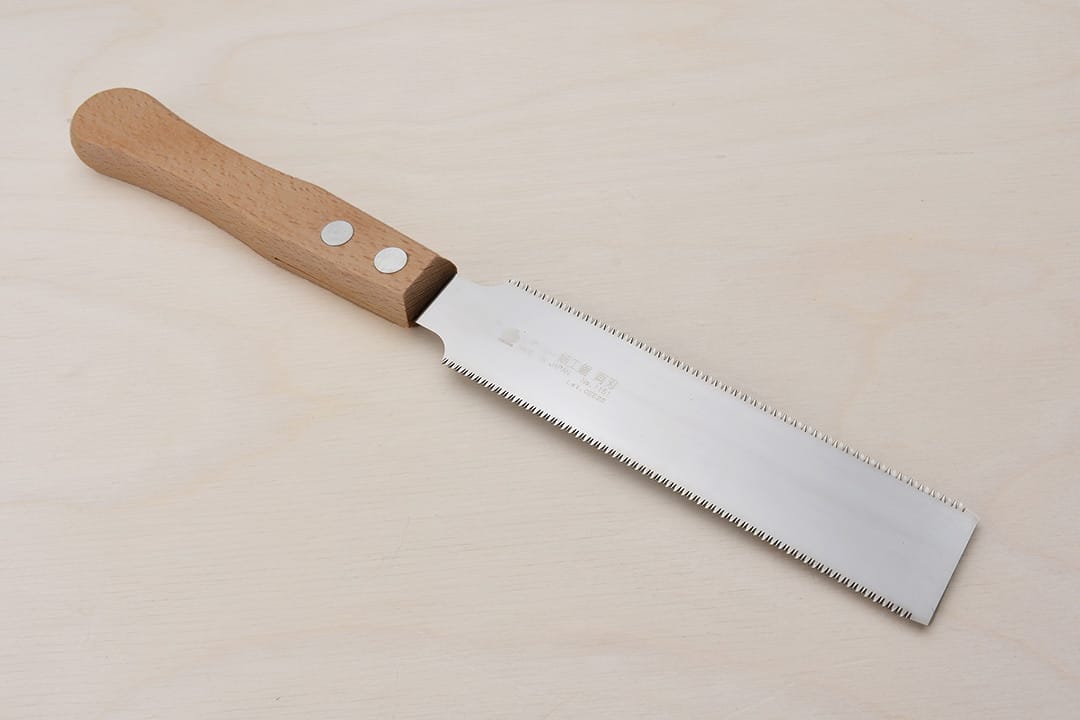
 

Flush cutting saws are delicate precision tools used to trim plugs, dowels, wooden nails and through tenons flush with the surrounding surface.

The crosscut teeth of this saw have absolutely no set, so they do not scratch the surface. The blade is only 0.3mm thick and extremely flexible, light pressure with the index finger of your other hand is all that is required to hold the blade down onto the workpiece and achieve a truly flush cut.

Blade length: 125mm
Overall length: 270mm
Blade thickness: 0.3mm
Pitch: 1mm x 1.3mm / 25 x 20 tpi
Set: 0.00mm per side
Beech wood handle
Non-replaceable blade

https://workshopheaven.com/gyokucho-japanese-set-of-4-saws-bestseller
(c) Workshop Heaven

The four most useful Japanese saws for Woodworkers2026-02-23T15:16:51+00:00

Essential Lutherie Tools

Here’s a list of hand tools that will get 99% of all luthier tasks complete:

  • pencil
  • 1 metre steel rule
  • slab of float glass or granite countertop as a reference plane
  • Steel carpenter’s square
  • marking knife
  • bench plane
  • panel saw
  • Coping saw / Fretting saw
  • round gouge
  • half-round rasp
  • cabinet scraper and burnisher
  • awl
  • callipers
  • needle files
  • jack plane
  • marking gauge
  • chisels: 1 very narrow, 1 very wide, a couple of intermediate sizes; e.g. 3 mm, 6 mm, 12 mm, 30 mm
  • Hand drill with an assortment of drill bits (optional clamp-in drill press)
  • 1/4” or 1/2” palm/hand router with an assortment of bits (1/2” will do a whole body in one cut, 1/4” you have to flip and use the guide bit)
  • Spokeshave to shape the neck and chamfers on body (alternatively a Shinto rasp and some good files)
  • Wood adhesive (titebond) and Cyanoacrylate (CA) glue (superglue)
  • An assortment of clamps: 4 medium G clamps, 4 speed clamps, and 2 long bar clamps.
  • Masking tape to clamp your binding.
  • Double sided tape to stick your templates and body to the table when you’re routing
  • more sandpaper than sense: 80, 120, 240, 320, 400, 600, 800, 2000
Essential Lutherie Tools2026-02-23T15:09:42+00:00

Kintsugi

Kintsugi (Japanese: 金継ぎ, lit. ‘golden joinery’), also known as kintsukuroi (金繕い, “golden repair”), is the Japanese art of repairing broken pottery by mending the areas of breakage with urushi lacquer dusted or mixed with powdered gold, silver, or platinum. The method is similar to the maki-e technique.

It can be seen as a metaphor for embracing your flaws and imperfections. There is beauty in out brokenness. The practice of repairing broken objects and acknowledging their history rather than discarding them resonates with the Buddhist principle of treating everything with respect and concern with wastefulness.

The exact origins of kintsugi are not known, however, historians date the start of the practice to the Muromachi period (1336–1573 CE). In the 16th century CE the repair technique appears to have already been in common use.

Kintsugi2026-02-23T15:06:49+00:00

Dorodango

Dorodango (Japanese: 泥だんご, lit. “mud dumpling”) is a Japanese art form in which earth and water are combined and moulded, then carefully polished to create a delicate shiny sphere.

The process has been refined into the art of the hikaru (“shining”) dorodango (光る泥だんご), which has a glossy surface.

A core of the ball is made of basic mud, which has been carefully shaped by hand to be as round as possible.

This core is left to dry, and then methodically and carefully dusted with finely sifted soil to create a crust several millimeters thick around the core.

This step may be repeated several times, with finer and finer grains of dirt in order to create a smooth and shiny surface.

A cloth then may be used to gently polish the surface.

The dorodango, once completed, may look like a polished stone sphere, but it is still very fragile.

The process requires several hours and careful focus so as not to break the ball.

Materials

  • Dry earth
  • Water
  • Plastic bag
  • Cloth
  • Patience

Process

Get dry dirt / soil and add water until it’s damp and muddy. Grab a handful and start shaping it into a ball. Try as hard as possible to squeeze the water out as you go.

Focus on making a round ball. When you have more or less a round ball, take some dry dirt / soil and sprinkle a small pile of it onto the ball and shake / wipe it off. This will leave the dry dirt stuck to the ball.

Keep doing this making sure to retain its round shape. It’ll take you a little while. When you think you are done, just keep going a little bit longer and then gently blow off any remaining dry dirt.

Put your ball in the plastic bag and seal it tight by tying a knot in it. Leave overnight for more water to get out of the ball.

When you remove the ball the next day, spend some time adding some dry earth to the ball again. Then coat your hands in the dry earth getting them dusty and then rubbing them all over the ball for half hour or so.

Finally, you can start to polish the ball with a cloth until it gets a lovely shine.

Dorodango2026-02-23T15:04:54+00:00

Sashimono

Sashimono” is a technique for assembling furniture and other wooden items without nails, using both simple and highly complex wood joints. Mortises or grooves called ‘hozo’ are carved into the wood in order to join two boards in a blind joint that’s not visible from the surface. Furniture makers are known as sashimono-shi (指し物師)

The term “Sashimono” derives from the traditional practice of using a woodwork ruler called a “monosashi” to carefully measure timber materials.

Edo Sashimono

Edo Sashimono” refers to the wood joinery that evolved through the 17th to 19th centuries. The technique was introduced in cabinetwork for Samurai families and wealthy merchants. The joints of Edo Sashimono are made so they’re barely seen from the outside. Although delicate in appearance, the joinery is strong and lasts generations. Edo Sashimono is designated by the Japanese Government as a Traditional Craft of Japan.

Tools

The tools commonly used by Japanese carpenters are divided into a few basic families.

Japanese saw (鋸, nokogiri), which cuts on the pull stroke, rather than the otherwise globally prevalent push stroke. This allows the blades to be quite thin in comparison to the Western saw. There are two main kinds of cutting teeth on Japanese saws: crosscut (横挽き, yokobiki) and rip (縦挽き, tatebiki). The rip and crosscut are combined in one blade, known as a ryoba (両刃, lit. ’dual edge’). The rip and crosscut patterns are also made in single-edged saws, kataha nokogiri (片刃), both with stiffening back pieces and without. The stiff-backed saws, known as douzuki (胴付き, lit. ’attached trunk’) are typically used in cutting fine joinery. There are many other types of Japanese saws as well: osae-biki (押さえ引き鋸, lit. ’press-cut saw’), used for flush-cutting pegs to a surface without marring the surface. The saw teeth have no set to one or both sides to accomplish this feat. There is the azebiki (畔挽き, lit. ’ridge saw’), which has cutting both rip and crosscut teeth, and is short and rounded in profile. It is used for sawing in confined areas and starting cuts in the middle of surfaces. There are many other types and sub-types of saw. Most saws sold in the West are mass-produced items with induction-hardened teeth and relatively cheap replaceable blades. The handmade forged saws are very laborious to make and involve more manufacturing steps in the forging to complete than planes or chisels.

Japanese plane (鉋, kanna), is most commonly a wooden block, or dai (台) containing a laminated blade, sub-blade, and securing pin. In the Japanese plane, the blade is fixed in position primarily by the plane’s abutments that are cut in the sides of the dai. This is similar to a still manufactured type of European wooden plane, in which the blade is fixed in place by tapping down upon a wooden wedge. Unlike a western plane, the support bed for the blade is not a flat surface in a Japanese plane – rather it is convex. The blade itself is tapered in thickness so as to wedge tightly into the dai when tapped down into place. The blade is also tapered in width to allow its projection to be adjusted by tapping it from side to side, so that a uniform shaving thickness can be attained. Japanese planes are generally operated by pulling rather than pushing, and work can be done in the seated position or using the whole body for more power. Considered part of the kanna family, the yarigana is an archaic type of Japanese plane resembling a spear. The yarigana is a single piece of steel with one end being used as a handle and the other forged into a leaf shaped blade. The carpenter holds the yarigana with two hands, perpendicular to his arms, and pulls towards his body producing a concave gouge in the timber. The yarigana was in universal use prior to the introduction of the block-mounted wood plane to Japan, and is today typically reserved for use on large circular columns or in cases where a more rustic appearance is desired in the final element.

Japanese chisel (鑿, nomi). There are bench chisels, paring chisels, striking chisels, heavy timber chisels and slicks, and myriad others for specialized applications. Like the planes, the blades are of laminated hard steel/soft steel construction. Bevel angle varies from 20˚ to 35˚ typically, with mortising and heavy chisels featuring steep angles, and paring chisels having shallower angles. It is common in Japan to work with softwoods, so many chisels are made with that in mind, and require the bevels be steepened if employed for harder woods.

Japanese gimlet (錐, kiri). The kiri is used for boring circular holes in a timber, often as the first stage in the hollowing out of a mortise. Though seemingly simple to use, the kiri is commonly considered one of the most difficult tools to master.

Inkpot (墨壺, sumitsubo). The sumitsubo is used for marking long straight lines onto various surfaces. A thread (tsuboito) is tied to a rounded piece of wood with a needle fixed at the end (karuko). The other end of the thread is passed through the small opening at the end of the sumitsubo (itoguchi), through the depression containing ink (ike) and wound around a spool (itomaki-guruma). The ink is stored in the ike soaked in silk wadding. Silk threads are used as tsuboito. To draw a line, the sumitsubo is held in the left hand and the karuko’s needle is fixed onto the surface determining the position of one end of the thread. The sumitsubo is gradually moved away from the karuko until the required length of the thread is unreeled at which point the rotation of the spool is stopped using the thumb. With the index finger the thread is pressed down at the required end point of the line. Using the right hand, the thread is pulled upwards into tension and then suddenly released, consequently hitting the surface and leaving a straight line of ink onto any surface, regardless of any surface irregularities.

Japanese axe and adze (ono (斧) and chōna (釿)).

Japanese hammer (玄能, Genno or Gennoh). There are several types of carpentry hammers. Some hammers are used for chisel work, some for positioning hand plane blades, some for hammering and pulling nails, and others for tapping out laminated hardened steel from base of plane blades and chisels.

Tools for measuring and marking include the bamboo pen (墨さし, Sumisashi), carpenter’s square (差し金, Sashigane), marking knife (切り出し, Kiridashi), the traditional single and multi-blade marking gauges (罫引, Kebiki and Kinshiro), among others.

Blades. Though a carpenter will typically fashion handles and woodblocks and set and sharpen their blades themselves, the blades themselves are forged by steel smiths and provided unmounted to the carpenter. Japanese steel has long enjoyed a high level of refinement, without which the fine surfaces and detail for which Japanese woodwork is renowned would not be possible. The blades used in the Japanese chisel and the Japanese plane shares similar constructive principles to the Japanese sword. A thin piece of extremely hard blade metal called ha-gane (鋼, lit. ’edge metal’) is forge-welded to a softer piece of metal called ji-gane (地金, lit. ’base metal’). The function of the softer base metal is to absorb shock, and to protect the more brittle ha-gane from breaking. This technology allows for the use of steels in the hagane which are harder than in use in Western chisels, typically Rockwell 62 and up, and also allows for the honing of a much finer edge than is typically known in carpentry outside Japan. When sharpening a blade, a Japanese carpenter will typically use three or more whetstones of varying coarseness, progressing from the roughest stone to the finest.

The traditional Japanese vice was a wedge of wood tied to a post with a coil of rope. The wood was inserted under the wedge and the wedge hammered down.

Vices of any sort are used far less in traditional Japanese carpentry than would be the case for equivalent tasks in the traditional crafts of the West. Many tasks in Japanese carpentry associated with building, involve very large pieces of timber, and in general, the weight of the timber and of the carpenter are used to stabilize the piece on which the carpenter is working. For this reason the carpenter’s horses used in Japan are much lower than their Western counterparts, and carpenters must always position themselves over their work. Much of the work on smaller pieces of material can be done in the seated position, and relies on the fact that the saws and planes both cut on the pull stroke, enabling stabilisation of the work using the body or shooting board.

Sashimono2026-02-23T15:02:37+00:00

Tsundoku

Tsundoku (積ん読) is the phenomenon of acquiring reading materials but letting them pile up in one’s home without reading them. The term is also used to refer to unread books on a bookshelf meant for reading later.

The term originated in the Meiji era (1868–1912) as Japanese slang. It combines elements of the terms tsunde-oku (積んでおく, “to pile things up ready for later and leave”), and dokusho (読書, “reading books”).

Tsundoku2026-02-23T14:59:50+00:00

Creativity: carving out time for free-floating periods of thought

After noticing a similar habit among highly creative people (Einstein, Mozart, da Vinci, etc), the neuroscientist Dr. Nancy Andreasen designed a brain-imaging study to explore the neural basis of this habit.

Essentially, these creative people all carved out time each day for…“Free-floating periods of thought,” Dr. Andreasen writes in her book, “The Creating Brain.”

The specifics of the habit differ.

Leonardo da Vinci, for example, would often sit in front of a painting “and simply think, sometimes for as long as a half day.”

Whereas Einstein loved to aimlessly drift at sea on a little wooden boat he called the “Tinef” (Yiddish for “piece of junk”). He had to be rescued by the Coast Guard so frequently that a friend eventually bought him an outboard motor for emergency use, but Einstein refused it. “To the average person, being becalmed for hours might be a terrible trial,” the friend said. “To Einstein, this could simply provide more time to think.”

Dr. Andreasen conducted the first study of brain activity during “free-floating periods of thought,” when the body is in a “resting state” and the mind is free to wander. “We found activations in multiple regions of the association cortex,” she writes. “We were not [seeing] a passive silent brain during the ‘resting state,’ but rather a brain that was actively connecting thoughts and experiences.”

Essentially, Dr. Andreasen found that the brain defaults to creativity. When the body is still and the mind is allowed to float freely, the brain engages in what she termed REST (“random episodic silent thinking”). And during REST, the brain “uses its most human and complex parts…areas known to gather information and link it all together.”

Separate from those that led to Dr. Andreasen’s study, there are many examples of creative people describing their own REST-ful habits:

The legendary designer Paula Scher: “I figured out every identity program I’ve ever done in a taxicab…you sit in the back…look out the window and you can sort of let your mind wander.”

One of the great songwriters of all time, Paul Simon: “I used to go off in the bathroom…turn on the faucet so that water would run—I like that sound, it’s very soothing to me—and I’d play, in the dark, letting my imagination wander.” (During one of these sessions, these words came to him: “Hello darkness, my old friend / I’ve come to talk with you again”—which became the opening verse of “The Sound of Silence”).

The filmmaker Quentin Tarantino: “I have a pool…And I hop in my pool and just kind of float around…and then a lot of shit will come to me. Literally, a lot of ideas will come to me. Then I get out and make little notes on that…That will be my work for tomorrow.”

So whether it’s sitting in front of painting, drifting in a boat, riding in a taxi, playing the guitar in a dark bathroom, or floating in a pool, if you want to be more creative, carve out time each day for “free-floating periods of thought.”

Creativity: carving out time for free-floating periods of thought2026-02-23T14:58:16+00:00

Vegan jambalaya

Ingredients

– 2 tbsp olive oil
– 1 large onion (180g), finely chopped
– 4 celery sticks, finely chopped
– 1 yellow pepper, chopped
– 2 tsp smoked paprika
– ½ tsp chilli flakes
– ½ tsp dried oregano
– 115g brown basmati rice
– 400g can chopped tomatoes
– 2 garlic cloves, finely grated
– 400g butter beans, drained and rinsed
– 2 tsp vegetable bouillon powder
– large handful of parsley, chopped

Method

– STEP 1

Heat the oil in a large pan set over a high heat and fry the onion, celery and pepper, stirring occasionally, for 5 mins until starting to soften and colour.

– STEP 2

Stir in the spices and rice, then tip in the tomatoes and a can of water. Stir in the garlic, beans and bouillon. Bring to a simmer, then cover and cook for 25 mins until the rice is tender and has absorbed most of the liquid. Keep an eye on the pan towards the end of the cooking time to make sure it doesn’t boil dry – if it starts to catch, add a little more water. Stir in the parsley and serve hot.

Vegan jambalaya2026-02-23T14:55:52+00:00

Stopping by Woods on a Snowy Evening

by Robert Frost (1922)

Whose woods these are I think I know.
His house is in the village though;
He will not see me stopping here
To watch his woods fill up with snow.
My little horse must think it queer
To stop without a farmhouse near
Between the woods and frozen lake
The darkest evening of the year.
He gives his harness bells a shake
To ask if there is some mistake.
The only other sound’s the sweep
Of easy wind and downy flake.
The woods are lovely, dark and deep,
But I have promises to keep,
And miles to go before I sleep,
And miles to go before I sleep.
Stopping by Woods on a Snowy Evening2026-02-23T14:54:22+00:00

Ozymandias

by Percy Bysshe Shelley (1818)

I met a traveller from an antique land,
Who said—“Two vast and trunkless legs of stone
Stand in the desert. . . . Near them, on the sand,
Half sunk a shattered visage lies, whose frown,
And wrinkled lip, and sneer of cold command,
Tell that its sculptor well those passions read
Which yet survive, stamped on these lifeless things,
The hand that mocked them, and the heart that fed;
And on the pedestal, these words appear:
My name is Ozymandias, King of Kings;
Look on my Works, ye Mighty, and despair!
Nothing beside remains. Round the decay
Of that colossal Wreck, boundless and bare
The lone and level sands stretch far away.”
Ozymandias2026-02-23T14:51:25+00:00